If you listen and reading into all of the AI talk, you’d think HR is about to be automated away.
Academic research says the opposite.
Two recent papers cut through the noise:
- Fenwick, Molnar & Frangos (2024) map three phases of AI in HR: “technocratic,” “integrated,” and “fully embedded”, and argue that as AI becomes more woven into work, HR’s job shifts from process owner to architect of human-AI collaboration.
- Bastida et al. (2025) describe HR’s journey “from automation to augmentation” using AI not just to speed up admin, but to enhance HR’s ability to make fair, nuanced, strategic decisions.
Put simply:
The more AI you embed, the more you need HR to lead on psychology, ethics, design, and employee voice, the things no tech function owns.
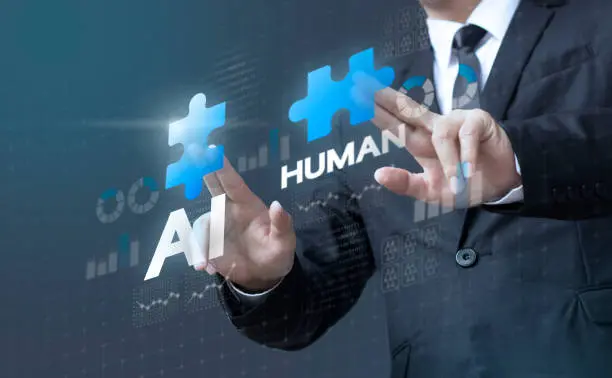
This post is about that role: HR as the human-AI bridge, not the team that just buys another chatbot.
And it’s where Scale Crew HR + our AI Readiness work are designed to sit.
1. The Academic View: HR Is the Human-AI Bridge
Fenwick & Molnar: The three phases of AI-in-HR
In Revisiting the role of HR in the age of AI, Fenwick, Molnar & Frangos describe three stages of AI-HR integration:
- Technocratic
- AI is used as point tools:
- Resume screening
- Chatbots for FAQs
- Basic analytics
- AI is used as point tools:
- HR strategy and structures barely change.
- Risks:
- Black-box decisions
- Bias and trust issues
- Fear of job loss
- “Tech did it” excuses when things go wrong
- Integrated
- AI is embedded into core HR processes:
- Talent acquisition pipelines
- People analytics and workforce planning
- Performance and engagement insights
- HR starts to:
- Use AI systematically
- Rethink workflows around AI information
- But the human/ethical side is still often playing catch-up.
- AI is embedded into core HR processes:
- Fully embedded
- Human and AI systems are tightly coupled across the organization:
- AI is in recruiting, learning, performance, mobility, workforce planning.
- At this point, HR’s role becomes:
- Guardian of psychological safety
- Designer of human-centric jobs and workflows
- Owner of ethical guidelines and fairness
- Channel for employee voice into AI decisions
- Human and AI systems are tightly coupled across the organization:
Their core point:
As you move from “technocratic” to “fully embedded”, AI is less of a pure tech problem and more of a human behavior, culture, and ethics problem, and that’s HR’s lane.
Bastida et al.: From automation to augmentation
In From automation to augmentation: Human Resource’s journey with Artificial Intelligence (2025), Bastida and co-authors frame AI in HR as a spectrum:
- Automation
- Using AI to:
- Automate repetitive tasks
- Speed up admin
- Reduce workload in HR ops
- Using AI to:
- Augmentation
- Using AI to:
- Improve decision quality (e.g. promotion and pay decisions)
- Spot patterns in skills, engagement, attrition
- Support strategic, fairer, more transparent choices
- Using AI to:
They stress that even as AI boosts efficiency, HR remains indispensable for:
- Ensuring fairness and non-discrimination
- Re-designing work, roles, and leadership models
- Supporting employees through role changes and reskilling
Net from both papers:
Modern research is not about “AI replacing HR.” It’s about HR’s mandate expanding into ethics, design, and workforce strategy in an AI-heavy organization.
2. The Three Phases in Plain Language (And Why They Matter)
Let’s translate the theory into something you can recognize in your own org.
Phase 1: Technocratic AI (tools without transformation)
You’re here if:
- AI shows up as:
- A resume screener in your ATS
- A basic HR chatbot on your intranet
- “Smart” features in your HRIS or LMS
- HR processes and policies are basically unchanged.
- AI decisions are:
- Poorly explained
- Lightly governed
- Framed as “the system says…”
Risks at this stage (Fenwick & Molnar call these out explicitly):
- Bias and unfairness baked into models and data
- Fear and resistance from employees
- HR’s credibility hit when decisions feel opaque or inhuman
Technocratic AI makes HR look more digital, but it doesn’t make the org more human-centric.
Phase 2: Integrated AI (smarter HR, same org design)
You’re here if:
- AI is now:
- Feeding into workforce planning
- Powering people analytics dashboards
- Influencing succession and performance insights
- HR starts to:
- Ask better questions of data
- Spot patterns and risks earlier
- Tune interventions more precisely
But:
- Job design, leadership models, and culture often haven’t fully caught up.
- AI insights exist, but:
- Managers don’t always know how to act on them
- Employees may not trust them
- Decision rights are muddy (AI vs manager vs HR)
Integrated AI is a step up, but without a human-centric operating model, it can still feel like “smarter surveillance” instead of “better support.”
Phase 3: Fully Embedded AI (Human-AI systems by design)
This is the destination the papers are pointing to and where very few orgs actually are yet.
Signs you’re moving here:
- HR has a clear blueprint for where AI belongs in:
- Recruiting
- Onboarding
- Learning & development
- Performance and rewards
- Career paths and mobility
- There are explicit answers to:
- What AI does
- What humans must decide
- How AI-assisted decisions are tested, explained, and challenged
- HR owns:
- Psychological safety around AI at work
- Human-centric job and org design
- Ethical guidelines and fairness criteria
- Channels for employee voice into AI policies and changes
Fully embedded AI doesn’t mean “more AI everywhere.”
It means better-designed collaboration between humans and AI, with HR as the architect.
3. The New HR Mandate in an AI-Driven Organization
Pulling Fenwick/Molnar and Bastida together, HR’s upgraded job description has at least four big responsibilities.
1) Design psychological safety for AI @ work
HR needs to move beyond “here’s the AI tool” to:
- Co-create with leaders an AI @ Work compact:
- Where AI is/isn’t used
- What it means for roles and careers
- What “time dividends” look like
- How AI-related mistakes are handled
- Make sure:
- Employees feel safe to experiment
- People can challenge AI outputs without fear
- Concerns about fairness, bias, or creepiness have a real channel
That’s how you prevent AI initiatives from becoming “technocratic experiments” people quietly resist.
2) Re-architect jobs and leadership for augmentation
HR should be leading the move from:
- Job descriptions that assume humans do everything →
- Roles designed around Human-AI teaming, where:
- AI handles pattern recognition, drafting, summarizing, and routing
- Humans handle nuanced judgment, context, coaching, and relationships
That includes:
- Rewriting job profiles and performance criteria
- Coaching leaders on how to lead AI-augmented teams
- Redesigning workflows so AI is built into how work flows, not bolted on
3) Build ethical guardrails and fairness into AI-in-HR
As AI touches hiring, promotion, pay, and exits, HR must:
- Define fairness criteria and thresholds with legal, risk, and DEI
- Require:
- Bias testing and monitoring for HR-related models
- Human review on high-stakes decisions
- Audit trails you can explain to a regulator or a candidate
- Build employee voice into AI governance:
- Feedback mechanisms
- Escalation paths
- Visible changes in response to concerns
Academic work is clear: if HR doesn’t do this, AI risks amplifying existing inequalities instead of helping reduce them.
4) Support people through role change and reskilling
AI-heavy orgs will:
- Shrink some roles
- Expand others
- Create entirely new ones
HR’s job:
- Identify who is most impacted, and how
- Offer reskilling and internal mobility paths, not just redundancy plans
- Help leaders talk honestly about:
- What’s going away
- What’s being augmented
- What new opportunities are opening up
Bastida et al. explicitly highlight HR’s role in supporting employees through role changes and reskilling as AI moves from automation to augmentation.
4. Quick Self-Check: What Phase Are You In and Who’s Steering?
Grab your HR function and be honest.
1) Which phase describes you best?
Technocratic: A few AI tools in recruiting or HR ops; strategy unchanged.
Integrated: AI feeds into people analytics and key HR processes; adoption is patchy.
On the way to embedded: You’re actively redesigning roles, workflows, and policies around Human-AI collaboration.
2) Who’s actually owning Human-AI collaboration?
HR has a clear role in AI governance, job design, and psychological safety.
AI lives mostly in IT/data; HR is brought in for “change communications.”
3) Do you have a view on automation vs augmentation?
- Yes – we’ve drawn a line between:
- What we automate
- Where AI only advises
- Where humans must decide
- No – vendors and tools are making that call implicitly.
If you’re mostly in the second column, you’re at risk of staying stuck in the technocratic stage, where AI happens to people, not with them.
Where The Scale Crew HR Fits In
This “Human-AI bridge” role is exactly where The Scale Crew works.
We bring:
- Scale Crew HR
- Fractional HR leadership with deep, practical experience in:
- Talent & recruiting
- Org design & performance
- Employee relations & culture
- Fractional HR leadership with deep, practical experience in:
- AI Readiness & Transformation
- A gated program that:
- Starts with “Should you?” (build, boost, buy, or not now)
- Aligns leaders on an AI @ Work compact
- Designs manager-first enablement and AI power user paths
- Builds the people and guardrail scaffolding before you scale AI
- A gated program that:
We don’t pitch AI that sidelines HR.
We treat HR as:
- The co-architect of how humans and AI will work together
- The owner of psychological safety, fairness, and employee voice in AI decisions
- The strategic partner for founders and executives who don’t want AI theater or a backlash
If You Want HR to Be the Human-AI Bridge (Not the Last to Know)
We’ll help you:
- Identify which phase you’re in (technocratic, integrated, or on the way to embedded)
- See where HR needs to step up as mediator between humans and AI
- Decide what belongs in:
- Automation
- Augmentation
- Human-only decision space
So your next wave of AI doesn’t just make HR “more digital” it makes your whole organization more human, more fair, and more ready for what’s coming.